
APR vs. interest rate: key differences
June 03, 2025

The information provided on this website does not, and is not intended to, act as legal, financial or credit advice. See Lexington Law’s editorial disclosure for more information.
A signature loan lets qualifying applicants borrow funds in exchange for a signed promise to repay the loan within a set time. Creditors will also require information concerning your income, credit history and debt-to-income ratio.
Signature loans are one of the many types of personal loans that borrowers can use for goals like debt consolidation and emergency expenses. This guide will take an in-depth look at signature loans and explore their relationship to credit scores.
Table of contents:
Signature loans are also called “character loans” and “good faith loans” due to their relatively lenient qualifications and requirements. These types of loans come with higher interest rates to make up for the lack of collateral required—and to encourage borrowers to repay their debt on time.
All unsecured loans are harder to qualify for because they don’t require collateral. Having a good credit score of at least 670 can open the door for signature loans. Lenders can look at your credit profile and see that you have a history of consistently paying off debts.
To get a sense of if you’d qualify for a signature loan, double-check your credit score and report. Borrowers with a good credit score, steady income and relatively low debt will likely qualify for a signature loan. Filling out a prequalification form can also help you check your eligibility with multiple lenders.
Here’s a general overview of the process for obtaining a signature loan:
Remember that applying for a signature loan results in a hard inquiry, which may cause a temporary drop in your credit score. Only apply for a loan that you know you can qualify for to avoid too many hard inquiries over a short period.
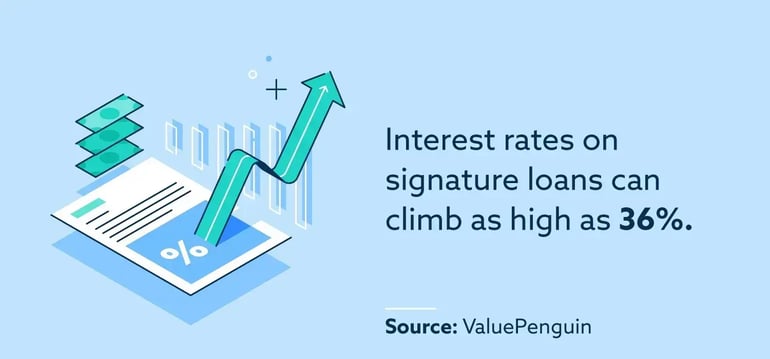
Signature loans tend to be more expensive than secured loans—the annual percentage rate (APR) on unsecured options ranges from 6 to 36 percent. You may also need to pay an origination fee, which could cost between 1 and 10 percent of the total loan amount.
Repayment terms for signature loans be as little as 12 months or as long as 15 years. Make sure you thoroughly read your loan agreement to understand how much time you have to repay your loan. Pay special attention to origination fees, late fees and any other factors that can increase the total cost of your loan.
If you choose to accept, make sure you know when your first payment is due. Setting up automatic payments is a great way to avoid late payments, which could have serious repercussions for your credit health.
Paying more than your minimum balance each month could save you money on interest. Just be sure your loan agreement won’t enforce prepayment penalties, which is when your lender charges a fee for paying off your loan early.
In most cases, you can borrow between $1,000 and $50,000 when you secure a signature loan. The exact amount you’ll be eligible for depends on your financial information, your credit profile, and current trends in the financial market.
Borrowers may use a signature loan for virtually any purpose unless the creditor identifies a specific purpose for the funds. Signature loan amounts may range from as little as $1,000 to hefty sums of $50,000, but they’re typically smaller due to the level of risk they pose to the creditor.
Common uses for signature loans include:
To clarify, a signature loan is a type of personal loan—just like how a car loan is a type of loan. Personal loans can be either secured or unsecured, the difference being the requirement of collateral. Since signature loans are unsecured, they don’t require assets as collateral, which makes them riskier for creditors to issue.
Because of the risky nature of signature loans, it’s typically very hard for someone with bad credit to qualify. However, some creditors offer signature loans to those with poorer credit. You may also have an easier time qualifying if you have a cosigner on the loan.
It’s worth keeping in mind that taking out an unsecured loan with such poor credit will likely be very expensive, and a secured loan may be a better option depending on your financial situation. If you’re considering a bad credit loan, talk to your financial advisor about the best options available.
As you work to improve your credit score, you’ll become eligible for increasingly lucrative loan options. Lexington Law Firm’s credit repair services can help get your credit back on track by addressing questionable items on your credit report.
Get in touch with Lexington Law to learn more about how our services could aid you on your credit journey.