

A bad credit score shows up on paper as a number: a 22% APR instead of 7% or a car payment that runs $200 higher every month for five years. Those costs are real, and they’re significant. The standard advice — shop around and pay it down — assumes you still have options. But high rates are exactly what make debt impossible to pay off, and a low score is what gets your application thrown out before anyone reads it.
The more serious damage is what never shows up on a statement, because it points to what didn’t happen. A new Lexington Law survey of 1,035 U.S. adults found that 61% of Americans have skipped applying for things like an apartment, a car loan, a credit card, or a job because they assumed their score would sink them. They turned themselves down before someone else could.
That’s the pattern this report tracks. People bid low on a cheaper home instead of the one they wanted, ask a parent for a loan instead of a bank, and never bother to request the credit report behind a denial.
But you have more legal footing than you probably realize. Anyone who pulls your credit report and turns you down has to tell you they did it and point you to the bureau that supplied it. Most people never learn that until they need to view their report, which is exactly where an attorney can help.

Key Takeaways
- 1 in 5 Americans under 45 settled for a cheaper home or apartment than they wanted because of their credit score, about four times the Baby Boomer rate.
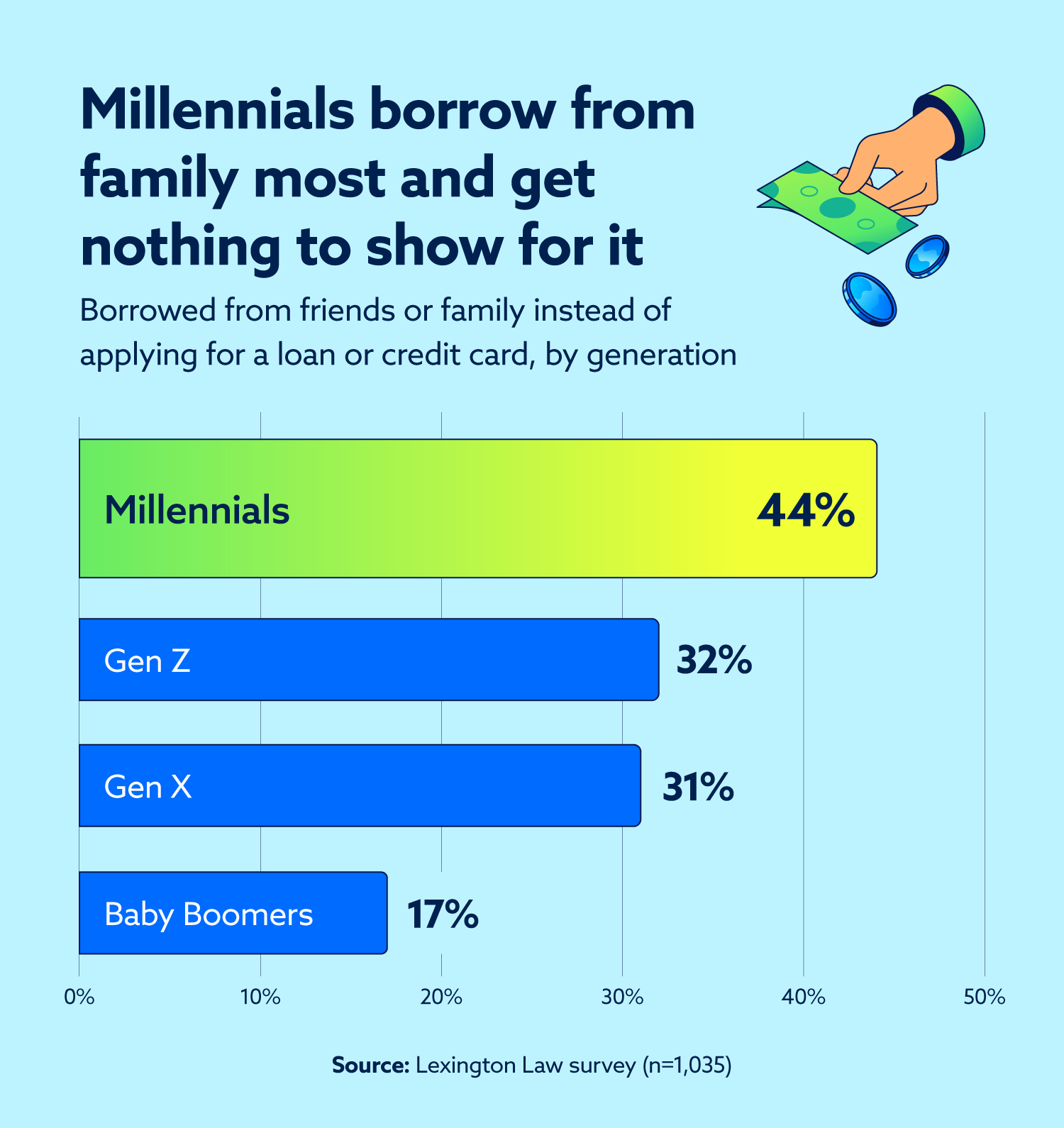
- 44% of Millennials have borrowed money from friends or family instead of applying for a loan or credit card, 2.5x the rate of Baby Boomers.
- 61% of Americans have avoided applying for something because they assumed their credit would disqualify them.
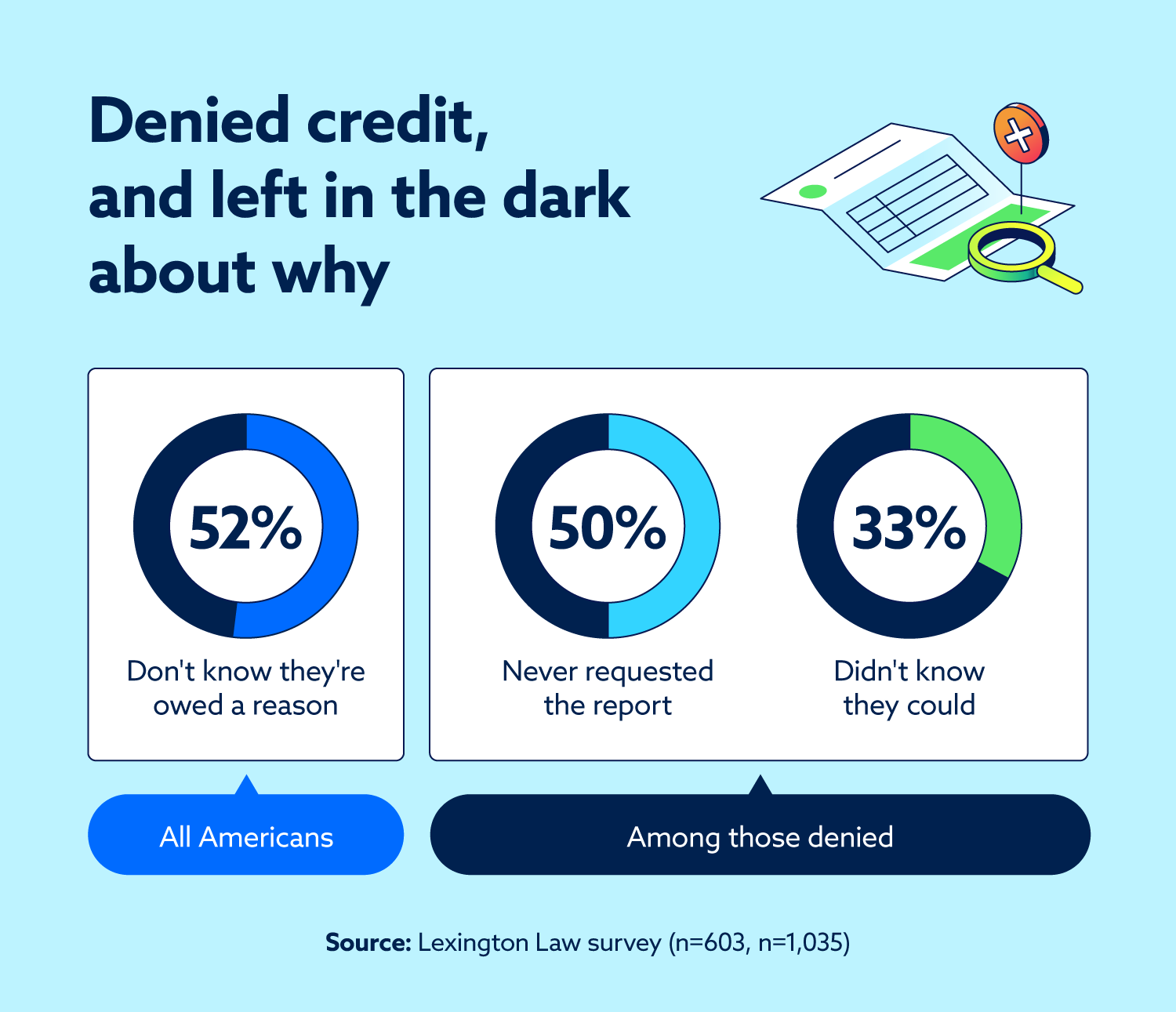
- 52% of Americans don’t know that anyone who denies them based on a credit report is legally required to tell them.
- 35% have found an error on their credit report, and people carrying an error are roughly twice as likely to have been denied a credit card.
1 in 5 Americans under 45 settled for a cheaper home because of their credit
A credit score doesn’t just change what you pay for a home. It changes which home you get to have. One in five Millennials (21%) settled for a cheaper place than they wanted because of their credit, and Gen Z is right behind them (19%). Baby Boomers were at only 5%, nearly four times lower than the under-45 rate.
Across the full sample, 13% settled for a cheaper place, and another 13% had to hand over a bigger deposit to get approved at all.
Landlords and mortgage lenders weigh your credit score heavily during approval. Where your number falls in the standard credit score ranges determines which of those penalties you’re likely to face.
The concentration under 45 makes sense. These are the people trying to buy a first home in a historically expensive market, and bringing a damaged credit file into that fight makes it nearly impossible to compete against buyers who have one less thing working against them.
Borrowing from family keeps 44% of Millennials locked out of the credit they need to recover
When the bank says no, the money has to come from somewhere. For 44% of Millennials, it came from a friend or a family member. That’s 2.5 times the rate for Boomers (17%). And here’s the trap: A loan from your mother builds nothing, no payment history or anything that shows up on a credit file the next time you apply. The workaround that solves this month’s problem is the same one that guarantees you’ll still have the same bad credit next year.
Gen X and Gen Z sit close together at 31% and 32%, respectively, and then Millennials break away from both. Life stage explains more than age does here. Millennials are hitting the exact moments credit gets tested hardest: a first mortgage after years of renting or student loan balances that are still dragging down their utilization. A lot of them are walking into those moments with a thin or damaged file.
Borrowing from relatives is the most common of the five substitutions the survey tracked, selected by 32% of respondents. Twenty percent have asked a friend or family member to co-sign. A co-signer isn’t a formality. If you miss payments, the damage lands on their credit report, and collectors can come after them for the full balance. Yet it’s one of the more common routes people take when they’re trying to get a loan with bad credit.
Another 20% have used a payday loan or high-interest lender, 14% paid a premium to skip the credit check entirely through rent-to-own or buy-here-pay-here financing, and 20% simply delayed the decision until their credit improved.
Every one of these costs something beyond money. Borrow from a lender, and you get disclosures and a dispute process. Borrow from your parents, and you could end up with an awkward Thanksgiving and a favor neither of you can quite get past.
58% have been turned down over their credit, and half never saw the report
Fifty-eight percent of Americans have been formally turned down for something because of their credit. That’s separate from the 61% who never applied at all, though there’s heavy overlap between the two groups.
Bad credit reaches well past the bank. Credit cards (41%) and personal loans (29%) lead the denials, but 13% of respondents were turned down for an apartment or rental home, and 8% lost out on a job.
That last one matters legally. Anyone who pulls your credit report and turns you down — whether that’s a bank, a landlord, an employer, etc. — has to send you an adverse action notice under the Fair Credit Reporting Act. It has to name the bureau that supplied the report, tell you that you can get a free copy within 60 days, and inform you that you can dispute anything wrong in it.
Lenders owe you even more than that: Under the Equal Credit Opportunity Act, a creditor has to give you the specific reasons you were denied. Yet 52% of Americans don’t know that any of this applies to them. Thirty-five percent aren’t sure, and 17% think no such requirement exists.
That lack of knowledge has real consequences. Among people who were actually denied something, half never requested the credit report used to make the decision, and a third didn’t ask for the report because they didn’t know they could. But you can actually request your credit report at any point, not just after a denial.
People with an error on their report are twice as likely to be denied a credit card
Skipping a review of your credit report can be costly, especially since the file itself is often the problem. Nearly 18% of Americans say they’re not at all confident that everything on their credit report is accurate, and 35% have actually found an error on theirs.
Those errors track with real liabilities. People who found an error on their report were denied a credit card at roughly double the rate, 53% versus 27% for people whose report came back clean.
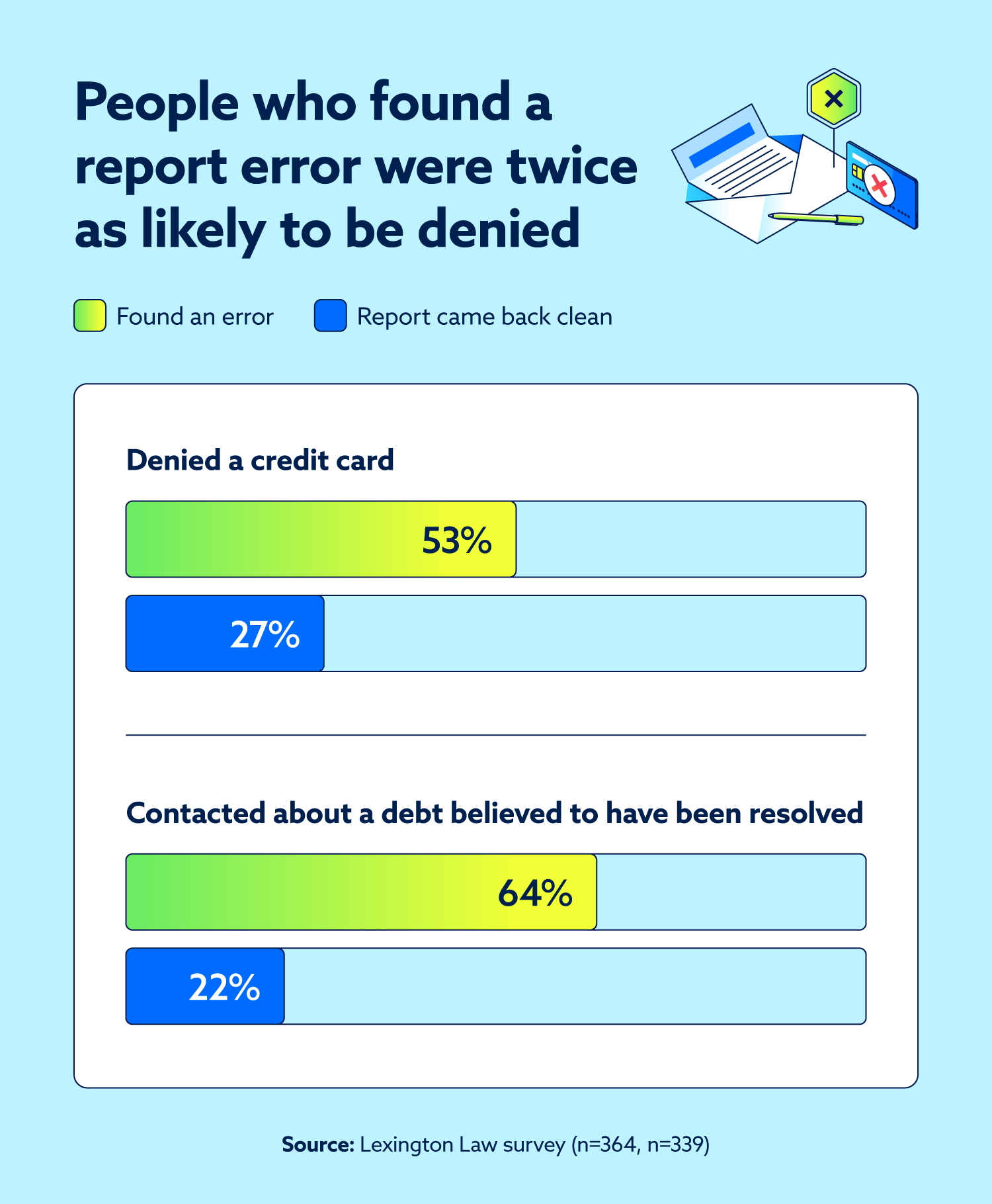
A sizeable split shows up outside new credit applications, too. Sixty-four percent of people with an identified error have been contacted by a debt collector about a debt they believed was already resolved, compared to 22% of people with a clean report, close to three times the rate. These findings show a correlation between report errors and old debt resurfacing rather than proof that one causes the other, but the overlap is hard to ignore.
There’s a knowledge problem running alongside the accuracy issue. Among people who were turned down, those who had found and disputed an error were more than twice as likely to have actually requested the free copy of the report used against them, 68% versus 31% for people who’d never checked their report closely enough to know either way.
The people least likely to know their rights may be the group most likely to be carrying an error they haven’t found yet. Cleaning up your credit starts with knowing what’s on your report in the first place.
The report is the one thing you can actually fight back on
A low score costs people the applications they never submit and the housing they settle for, and many never see the file behind either decision.
What stands out in this data is how many people accepted a credit decision without ever seeing the information behind it. Consumers have rights under the Fair Credit Reporting Act that exist precisely for moments like these, and most people never learn what those rights actually cover until they’re standing in the middle of a denial.
Those protections only work when people know to use them. Thankfully, finding something wrong on a report is exactly the kind of situation an attorney can walk someone through, since the dispute process itself has real procedural steps most people have never had a reason to learn.
Request your report the moment you’re turned down for anything, even a cell phone plan or a utility account. It’s free, and it’s a legal entitlement most people don’t know they have.
Read the report closely instead of skimming it. People who found an error were roughly twice as likely to be denied a credit card and nearly three times as likely to hear from a collector about a debt they thought was settled.
Dispute what’s wrong. Lexington Law’s attorneys can review a report and challenge inaccurate items with the bureaus on your behalf. Get your free credit report assessment to see where yours stands.
Methodology
The survey was conducted by Centiment for Lexington Law. The survey was fielded between August 7, 2026, and August 16, 2026. The results are based on 1,035 completed surveys. In order to qualify, respondents were screened to be residents of the United States and over 18 years of age. The sample was balanced to U.S. Census proportions on age, gender, and census region. Data is unweighted, and the margin of error is approximately +/-3 percent for the overall sample at a 95 percent confidence level.