
Years of high prices and tight household budgets should have pushed Americans toward visible financial trouble by now. A record $18.8 trillion in household debt seems to back that up at first glance.
A new Lexington Law survey of 1,028 U.S. adults tells a different story. People are juggling multiple obligations and mostly keeping up. Fifty-six percent have never missed a due date or defaulted on a loan, and 29% reported that none of the listed record types, from missed payments to hard inquiries, were tracked on their credit report.
But keeping up isn’t the same as getting ahead, and the people feeling it most aren’t who you’d expect: 54% haven’t made progress on their overall debt balance in the past year, and it’s not the lowest earners or the worst credit scores that are driving that number.

If the problem isn’t payment behavior, the fix probably isn’t either. What matters more is whether someone’s credit report actually reflects how carefully they’ve managed their money.
Key Takeaways
- Three in four Americans carry household debt.
- 54% haven’t reduced their overall debt balance in the past year.
- 41% carry $10,000 or more in non-mortgage debt.
- 56% have never missed a due date or defaulted on a loan.
- Middle-income households report the highest rate of growing credit concern, at 31%.
Three in four Americans carry debt, and most of it isn’t going anywhere
Debt is nearly universal, with three in four households carrying some form of it. Credit cards lead the way (43%), ahead of mortgages (27%), auto and similar loans (22%), and personal loans (19%). That ordering is very telling. Mortgages are secured by a house. Credit cards and personal loans aren’t, which means unsecured debt sits at the top of the list, carrying higher rates and fewer built-in protections when money gets tight.
The size of people’s balances varies just as widely as the type. Forty-one percent carry at least $10,000 in non-mortgage debt. But the most common balance range is actually the smallest one: 17% put their total non-mortgage balance between $1 and $999, although the distribution is fairly evenly split across the range.
And that spread doesn’t predict who’s making progress, with 30% saying their debt stayed roughly the same and 24% saying it increased over the last 12 months. Only 21% saw their balance shrink, and a mere 15% paid it off entirely.
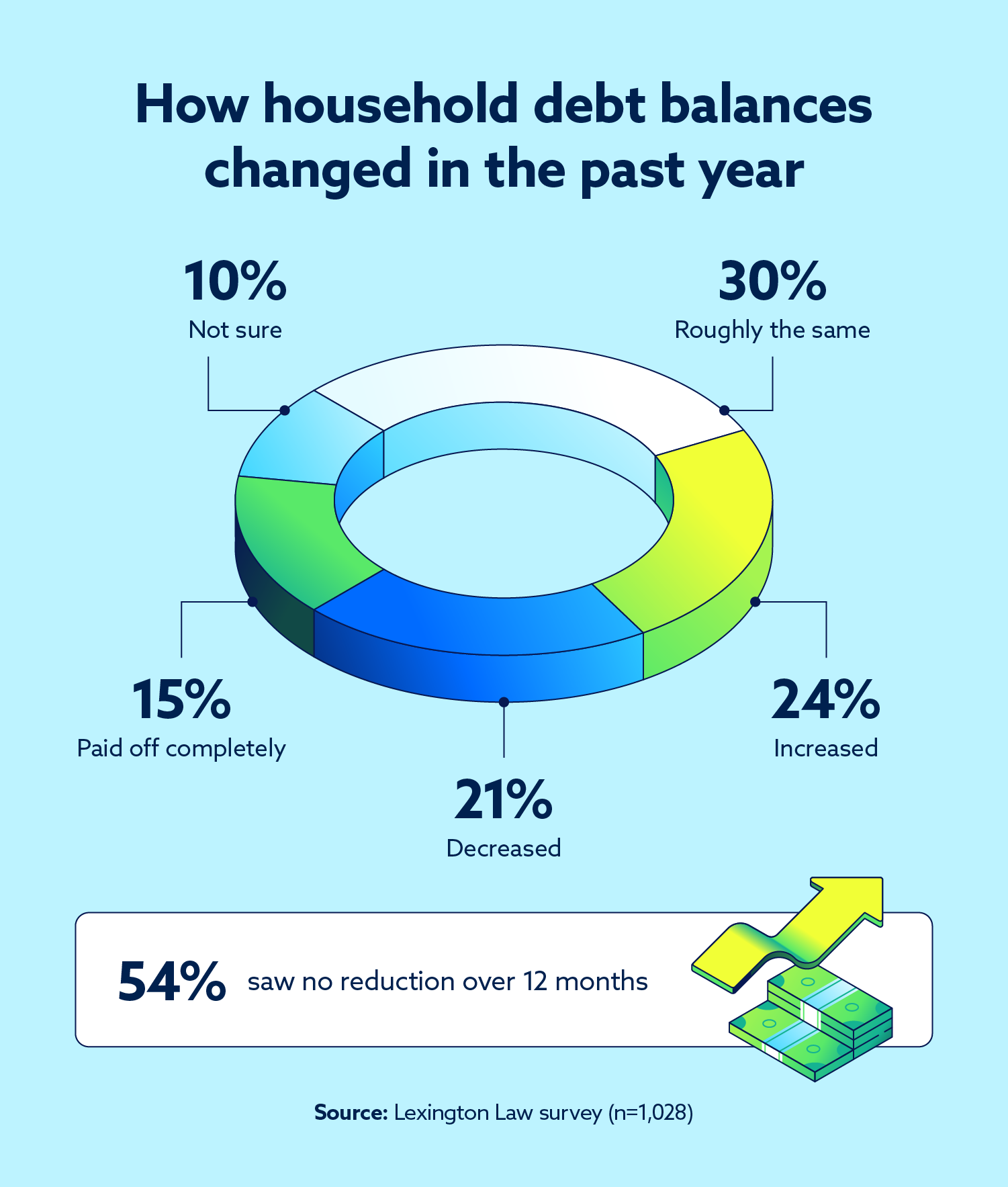
After a year of payments for more than half the sample, the balance at the bottom of the statement looks the same or worse than it did twelve months ago. That’s 54% of respondents seeing no reduction in their balance over the past 12 months. That’s not because people have stopped trying. Most of them are doing exactly what they’re supposed to do, and the number still won’t move.
Most Americans are paying on time. Their balances still aren’t moving.
If debt were spiraling the way the topline number suggests, you’d expect widespread missed payments and credit reports full of collections. That isn’t what shows up in the data.
Well over half the sample (56%) has maintained a clean record on credit card and loan payments. Nearly 3 in 10 didn’t report any of the specific record types the survey asked about, which included missed payments, collections, a new credit card, and bankruptcy. Not every item on the survey list hurts your credit score, but several of them qualify as derogatory marks. Having a clean showing across all nine is an excellent signal of financial discipline.
But financial discipline alone doesn’t move the balance. A timely minimum payment every month still leaves the principal largely intact, especially at current interest rates.
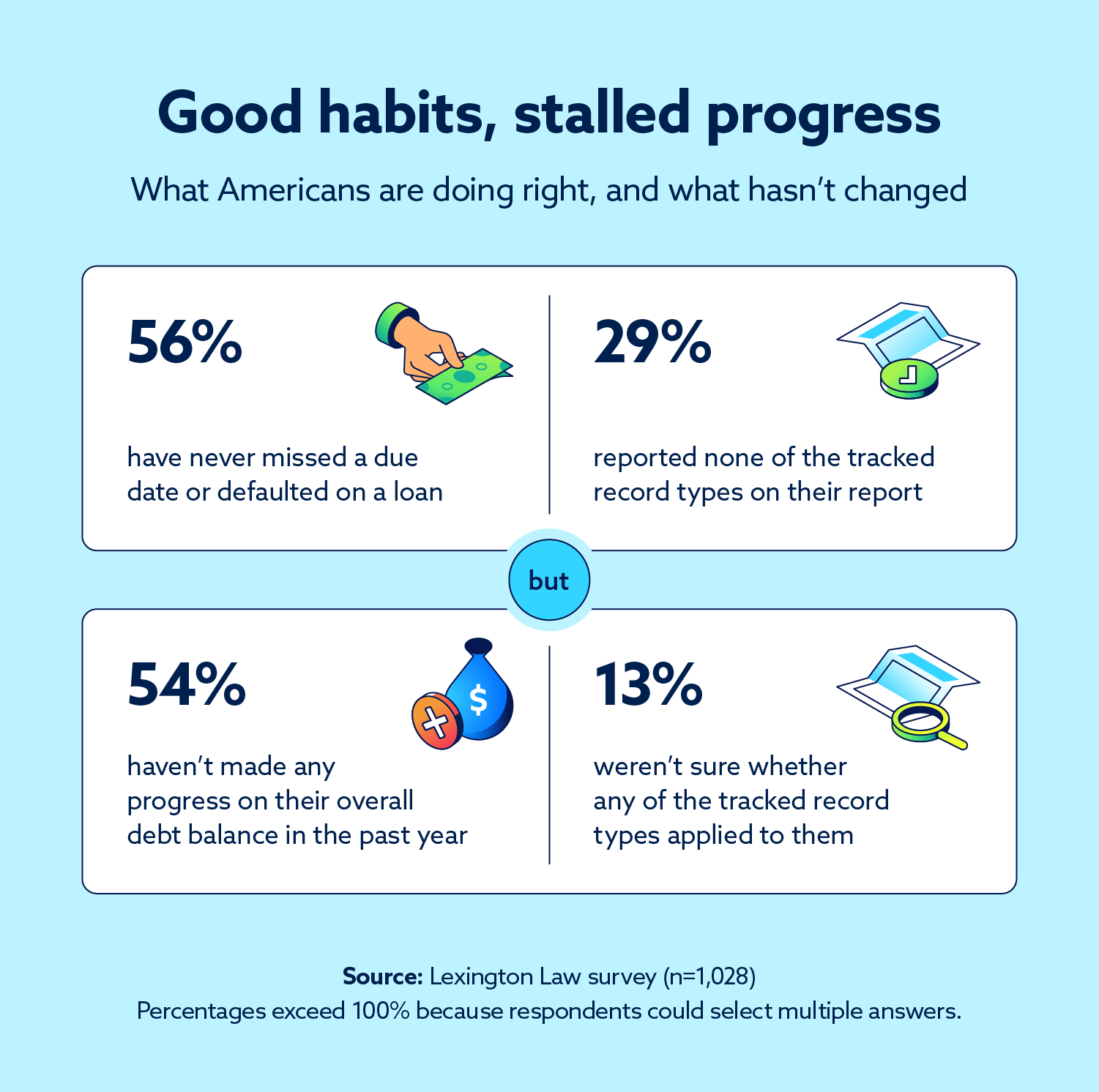
Good habits also don’t guarantee that someone actually knows what’s on their report. Thirteen percent of respondents weren’t sure whether any of the tracked record types applied to their report. That’s the kind of blind spot worth checking before assuming everything’s fine with your credit report. You could have an item on your report that you aren’t accounting for, and you wouldn’t know it without looking.
Discipline and awareness, then, are two different things, and this survey shows plenty of people have one without the other. Most are still keeping up with their debt payments. But it’s harder to keep up once someone actually falls behind.
44% of Americans who miss a payment watch their score drop
Forty-five percent of respondents have missed a due date or defaulted at some point. Twenty-seven percent missed by fewer than 90 days, 16% missed by 90 days or more, and 10% defaulted outright. Some respondents had more than one of these issues.
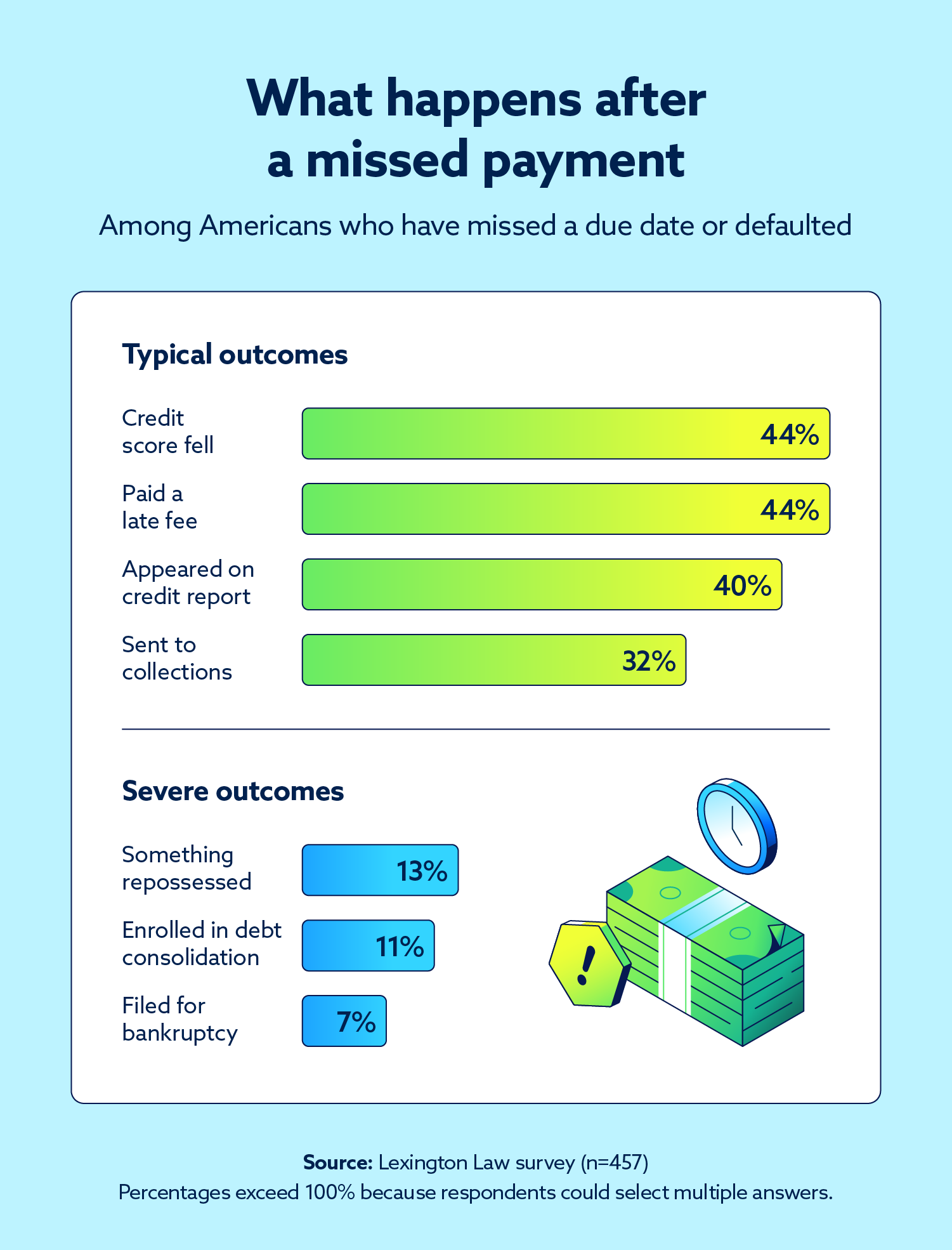
What happened next follows a predictable pattern. Among respondents who missed or defaulted, 44% saw their credit score fall, 44% paid a late fee, 40% saw it show up on their credit report, and 32% had the bill sent to collections. A late fee gets paid off quickly. A mark on a credit report doesn’t disappear nearly as fast.
The more severe outcomes are less common but harder to undo: 13% had something repossessed, 11% enrolled in a debt consolidation program, and 7% filed for bankruptcy. And each of these long-term outcomes started with a single missed due date. These are exactly what an attorney-led review is built to untangle, since knowing how to fix your credit afterward takes more than just paying down what’s owed.
What respondents didn’t do in response to these financial hits is revealing. Only 17% called their lender to negotiate, which means the majority accepted the consequences without contesting them. Negotiating can help even when a debt is legitimate, and it’s crucial when it comes to removing a late payment that shouldn’t be there in the first place.
Contesting something on your report can feel like a logistical and emotional hassle, which may be part of why so few people do it. Even people whose credit hasn’t taken a hit yet worry about it.
Middle-income Americans and those with fair credit are the most worried about their credit
Credit anxiety doesn’t run highest with the lowest earners, as you might assume. It peaks among middle-income households instead: The two middle-income brackets ($50,000-$99,999) combine to account for 31% who report growing concern, compared with 24% of those earning under $50,000 and 20% of those earning $100,000 or more.
The credit-score data tells a more expected story. Thirty-nine percent of respondents with fair credit say they’ve grown more concerned about their credit over the past year, compared with 24% of those with good credit, 19% with very good credit, and 12% with excellent credit. Poor-credit respondents reported similarly high levels of concern, though the sample size was smaller.
Fair-credit respondents are also the most likely to carry credit card debt (52%) and Buy Now, Pay Later balances (21%). They also report the highest rate of stalled or growing balances of any score band (67%).
These data points suggest there’s a group of borrowers with enough to lose and not enough margin to absorb a setback. Combine this group with those who are conscientiously making debt payments but making little headway, and it’s reasonable to think that a significant portion of the population could benefit from knowing what’s currently sitting in their report, so they can do something about it.
When doing everything right isn’t enough, check the report
Payment behavior isn’t the problem for most people in this survey. They’re current on their bills, but their balance still isn’t moving. Thirteen percent of respondents weren’t sure whether items like missed payments or collections were currently listed on their report at all, which makes it hard to know whether their familiarity with their report itself is part of what’s holding them back. We asked Moriah Beaver, an attorney at Lexington Law Firm, what someone should do once they suspect something’s wrong.
Beaver encourages consumers to review credit reports regularly to stay updated and catch potential inaccuracies as soon as they arise. Consumers can currently pull credit reports weekly from each of the three main credit bureaus on annualcreditreport.com. She states, “Under the Fair Credit Reporting Act, you have the right to dispute information you believe is inaccurate or incomplete and the credit reporting agencies have the responsibility to investigate legitimate disputes.”
When something looks wrong, Beaver recommends documenting it before acting by noting the account, the date, the reported status, and which bureaus are showing it, since the same account is often reported differently across all three. She also stresses the importance of keeping copies of all disputes sent and responses received.
While you can send disputes on your own, the process takes time most people don’t have. That’s where Lexington Law’s attorney-led review comes in. The team works with you to identify entries that are inaccurate or unsubstantiated, then files disputes where the evidence supports it.
Methodology
The survey was conducted by Centiment for Lexington Law Firm. It was fielded between August 12, 2026, and August 17, 2026, and is based on 1,028 completed responses. To qualify, respondents were screened to be residents of the United States aged 18 or older. Data is unweighted, and the margin of error is approximately +/-3% for the overall sample at a 95% confidence level.
Note: Articles have only been reviewed by the indicated attorney, not written by them. The information provided on this website does not, and is not intended to, act as legal, financial or credit advice; instead, it is for general informational purposes only. Use of, and access to, this website or any of the links or resources contained within the site do not create an attorney-client or fiduciary relationship between the reader, user, or browser and website owner, authors, reviewers, contributors, contributing firms, or their respective agents or employers.
External Sources
- Center for Microeconomic Data, Federal Reserve of New York. (Q2, 2026). https://www.newyorkfed.org/microeconomics/hhdc.html
- Fair Credit Reporting Act. https://www.ftc.gov/legal-library/browse/statutes/fair-credit-reporting-act