


Key takeaways
- A convenience check is a paper check issued by your credit card company that draws against your credit limit — not your bank account.
- Unlike a standard purchase, convenience checks are almost always processed as cash advances, meaning interest typically begins accruing the moment the check clears with no grace period.
- Most convenience checks carry a transaction fee of 3 to 5 percent of the amount written, which is charged immediately regardless of any promotional APR offer.
- Using convenience checks for large amounts can cause a sudden spike in your credit utilization ratio, which accounts for roughly 30 percent of your credit score.
- Unused convenience checks should be shredded — not thrown away whole — because a stolen check can be used to commit fraud against your account.
That book of checks that just arrived from your credit card issuer might look like a financial windfall, but using them without a plan can be a costly mistake. Credit card convenience checks allow you to tap into your credit limit using paper instead of plastic — but unlike a standard purchase, they often come with immediate interest, steep fees and no consumer protections if something goes wrong.
Understanding what a convenience check is—and when it actually makes sense to use one — is essential before you sign on the dotted line. Issuers such as Credit One regularly mail these checks to cardholders as a promotional tool. A Credit One convenience check, for instance, works the same way as checks from any other issuer: it draws against your credit limit and is processed as a cash advance with the same fee and interest implications. This guide breaks down how convenience checks work, the real cost of using them and how to protect your credit score from the pitfalls that catch most borrowers off guard.
What Is a Convenience Check?
A convenience check is a paper check — sometimes called a credit card check — issued by your credit card company that draws against your credit card limit rather than a checking account. When you write a convenience check, you are creating credit card debt — similar in concept to swiping your card, but with one critical difference: convenience checks are almost always processed as a cash advance, not a standard purchase.
This distinction matters significantly. A standard credit card purchase gives you a grace period—typically 21 days or more — during which no interest accrues if you pay your balance in full. Convenience checks usually do not. Interest begins accruing the moment the check clears, and you will also owe a transaction fee of 3 to 5 percent of the check amount immediately. On a $300 check, that means you owe $315 right away — before a single day of interest has been charged. To understand how this affects your overall credit card limit and available balance, review your card’s terms before writing any check.

What Are Convenience Checks Typically Used For?
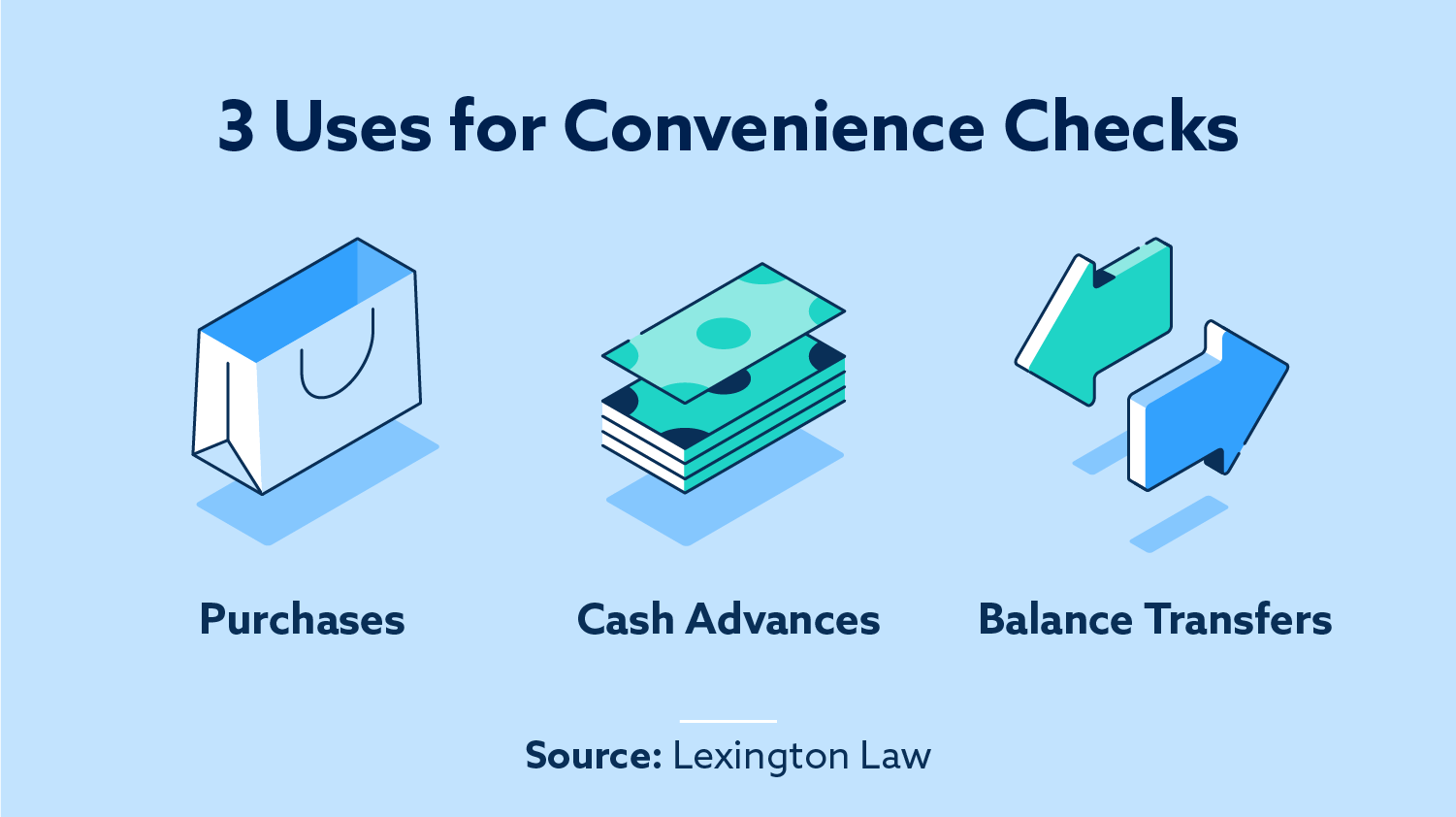
Most people who use convenience checks do so for one of three specific situations — not as a routine substitute for swiping their card. The difference between a standard use and a strategic use often determines whether a convenience check saves money or costs far more than expected.
Paying Non-Card-Accepting Vendors
Some vendors — home contractors, specialized mechanics, landlords and certain service providers — do not accept credit cards. A convenience check lets you access your credit line in those situations. However, this should be a last resort. Because interest starts accruing immediately and no grace period applies, treating this like an interest-free purchase will quickly lead to an unexpected balance. If you find yourself in this situation frequently, it may be worth exploring options like building a rainy day fund specifically for cash-only vendors.
Strategic Balance Transfers
Balance transfer is the most common strategic use of convenience checks. If your issuer sends a 0% APR promotional check, you can write it to pay off a high-interest credit card on a different account — effectively moving the balance to a lower-rate vehicle. However, even with a 0% promotional rate, you will typically pay a 3 to 5 percent transaction fee upfront. Before proceeding, calculate whether the interest savings over the promotional period exceed that fee. If the promotional window is short or the transferred balance is small, the math may not favor the transfer. For a structured approach, see our guide on the right way to pay off debt.
Accessing Liquid Cash
By writing a convenience check to yourself and depositing it into your bank account, you can access cash for an emergency. This is technically a cash advance — and it is one of the most expensive ways to borrow money. Cash advance APRs frequently reach 25 percent or higher, and the transaction fee applies on top. Using this method for anything other than a genuine financial emergency is rarely advisable. If your situation requires this level of access to cash, it may be worth revisiting your emergency savings strategy altogether.
The Drawbacks of Convenience Checks
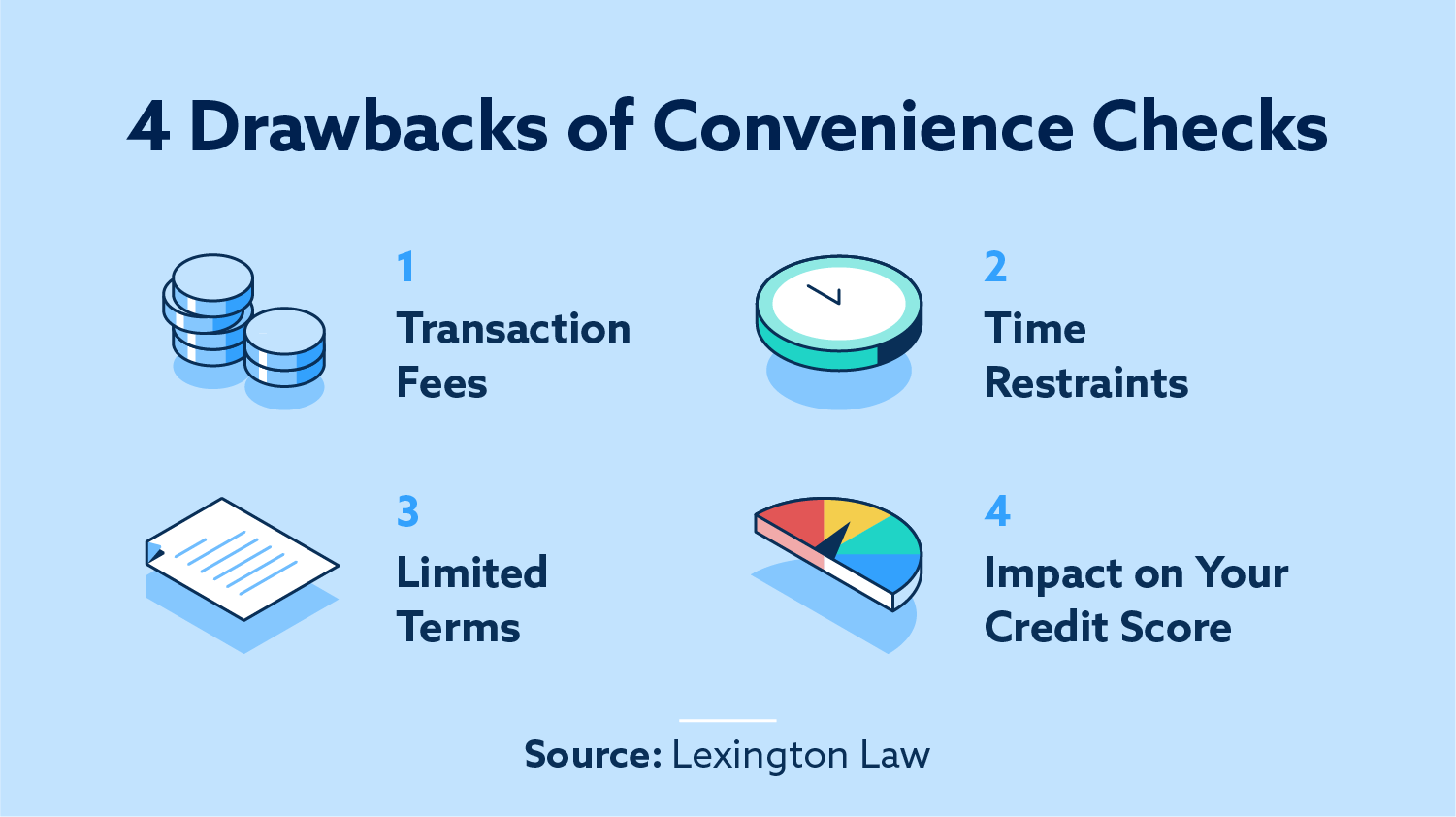
For most consumers, convenience checks are not a minor inconvenience — they are potential financial landmines. Understanding each drawback before you write a check is the difference between a deliberate financial tool and an accidental debt spiral.
Immediate Interest
Unlike standard credit card purchases — which give you roughly 21 days interest-free if you pay in full — convenience checks begin accruing interest the moment they clear. There is no grace period. This is the single most important distinction to internalize before using one, because a borrower who expects the same terms as a card swipe will find an unexpected interest charge on their next statement.
Steep Transaction Fees
Convenience checks almost always carry a cash advance fee — typically 3 to 5 percent of the amount written. This fee appears on your statement the same cycle the check clears, regardless of any promotional APR offer. On a $2,000 balance transfer check, a 4 percent fee means $80 out of pocket before a single day of interest. Look for the transaction fee in the Schumer Box on your card agreement or in the promotional materials that accompany the checks. If it is not disclosed, call your issuer before writing the check.
Expiration of Promotional Rates and Deferred Interest
Promotional 0% APR offers tied to convenience checks come with expiration dates — and some of them include a deferred interest clause. Deferred interest means that if you carry any remaining balance when the promotional period ends, you may be charged all the back-dated interest that accumulated during the promo period — not just interest going forward. A $3,000 balance with 12 months of deferred interest at 24% APR can generate a surprise charge of several hundred dollars if even one dollar remains when the clock runs out. Always confirm whether your offer uses a “0% APR” structure or a “deferred interest” structure — they behave very differently.
Credit Score Damage
Convenience checks drive up your credit utilization ratio — the percentage of your available credit currently in use. Credit utilization accounts for roughly 30 percent of your credit score, making it one of the most consequential factors in your profile. If you have a $10,000 limit and write a $6,000 convenience check, your utilization jumps to 60 percent on that card — well above the 30 percent threshold most scoring models treat as the upper boundary of responsible use.
Because convenience checks are often used for large, one-time expenses, they can cause a sudden, sharp drop in your score that takes months to reverse — even if you pay the balance down quickly afterward. The initial spike is immediate; the recovery is gradual. For anyone actively working to rebuild their credit profile, this kind of volatility is particularly damaging. For strategies to minimize the impact, see our guide on habits that help improve your credit score.
Lack of Consumer Protections
When you swipe a credit card for a purchase, the Fair Credit Billing Act gives you the right to dispute charges for goods or services not delivered as promised. Convenience checks do not carry that protection. Once a convenience check clears, the transaction behaves more like cash or a wire transfer — the money is gone, and the bank generally will not reverse it on your behalf if a contractor does poor work or a vendor fails to deliver.
Physical checks also carry an interception risk that card transactions do not. A stolen or altered check bearing your signature and account details is harder to dispute than a fraudulent card charge, because the physical signature serves as an authorization that issuers treat differently than a card-network dispute. This is one reason unused convenience checks should never simply be discarded — they should be voided and shredded immediately.
Is It Ever a Good Idea to Use a Convenience Check?
Convenience checks make financial sense in one narrow scenario: when you receive a genuine 0% APR offer (not deferred interest), you have a high-interest balance on a different account you cannot move via a standard balance transfer, and the interest savings over the promotional period clearly exceed the 3 to 5 percent transaction fee. In that specific case, the math can favor using the check. Outside of it, the combination of immediate interest, cash advance fees and the absence of consumer protections makes convenience checks one of the more expensive ways to access credit.
Using convenience checks to access quick cash is almost always a red flag scenario. If you find yourself reaching for a convenience check because you have no other option, the underlying issue is likely a shortage of liquid savings rather than a credit access problem. The check may solve the immediate need, but it will add to a debt load that is already stretched. Before writing the check, compare the transaction fee plus the projected interest against the cost of any alternative — including a personal loan or a dedicated credit line — to confirm you are choosing the least costly path.
Navigate Your Credit With Confidence
Now that you understand what a convenience check is and the hidden costs attached to it, you are better positioned to make deliberate decisions about your credit line. The risks — immediate interest, cash advance fees, utilization spikes and the absence of consumer protections — are avoidable with the right information. But for borrowers whose credit reports already reflect the consequences of high utilization or other derogatory items, knowledge of those risks only helps going forward.
Managing credit is not just about avoiding costly tools like convenience checks — it is also about ensuring your credit report accurately reflects your financial history. Whether you are working to address high utilization, challenge inaccurate items or understand how to rebuild your credit after a difficult period, Lexington Law Firm® is here to help. Our advocates review your credit report, work with you to identify potentially inaccurate or unfair entries and dispute them with the bureaus and creditors. To learn more about how we can help, visit our services page today.
What Is A Convenience Check?: Frequently Asked Questions
Convenience checks can generally be cashed or deposited anywhere a standard personal check is accepted — including your own bank, credit unions or check-cashing services. Most institutions may limit the dollar amount available for immediate cash, though a larger deposit may be accepted with a hold of a few business days while the check clears. Check with your bank about their specific policies before relying on same-day access to the funds.
Unused convenience checks should be voided and shredded immediately — never discarded whole. A stolen check carries your account number, routing-equivalent information and a signature line that can be completed by a fraudster, making it a direct tool for identity theft and account fraud. After shredding any unused checks, call your credit card issuer to request that they stop sending additional books. Also make it a habit to regularly review your credit report for any unauthorized activity or accounts you do not recognize.
In most cases, convenience checks do not earn cash back, points or travel rewards. Because they are processed as cash advances rather than standard purchases, they fall outside the earning categories of most rewards programs. This applies across issuers. You can review your card’s rewards terms before writing a check, but the answer is almost always no, and assuming otherwise can lead to a disappointing outcome on top of the fees and interest already attached.
Note: The information provided on this website does not, and is not intended to, act as legal, financial or credit advice. See Lexington Law’s editorial disclosure for more information.
Articles have only been reviewed by the indicated attorney, not written by them. The information provided on this website does not, and is not intended to, act as legal, financial or credit advice; instead, it is for general informational purposes only. Use of, and access to, this website or any of the links or resources contained within the site do not create an attorney-client or fiduciary relationship between the reader, user, or browser and website owner, authors, reviewers, contributors, contributing firms, or their respective agents or employers.