


Credit mix refers to the different types of credit accounts a person has open at any given time.
Key takeaways
- Credit mix measures the variety of credit accounts on your report and makes up about 10 percent of your FICO® score.
- The two core categories are revolving credit (credit cards, HELOCs) and installment credit (auto loans, mortgages, student loans).
- A good credit mix generally includes at least one revolving account and one installment account managed responsibly over time.
- Opening new accounts just to diversify your mix can backfire through hard inquiries and a lower average account age.
- Payment history and credit utilization carry far more weight than credit mix, so address those first if your score needs work.
In plain terms, credit mix is the variety of credit accounts on your report, split between revolving credit (like credit cards) and installment credit (like auto loans or mortgages), and it accounts for roughly 10 percent of your FICO® score. Lenders look at this mix to gauge how well you handle different kinds of debt, which can influence both your score and your future financing options.
Most guidance about building credit focuses on paying bills on time and keeping balances low. Those habits still matter most, but credit mix plays a supporting role: it can tip a borderline application in your favor or, if neglected, leave a gap in an otherwise strong credit profile. This guide breaks down what counts toward your mix, what a good mix actually looks like and how to improve it without taking on debt you don’t need.

Why Is Credit Mix Important?
Credit mix matters because it signals to lenders how you handle different repayment structures, which can affect both your credit score and the financing terms you qualify for later. A borrower who manages a credit card and a car loan responsibly looks like a lower risk than one with no track record outside a single account type.
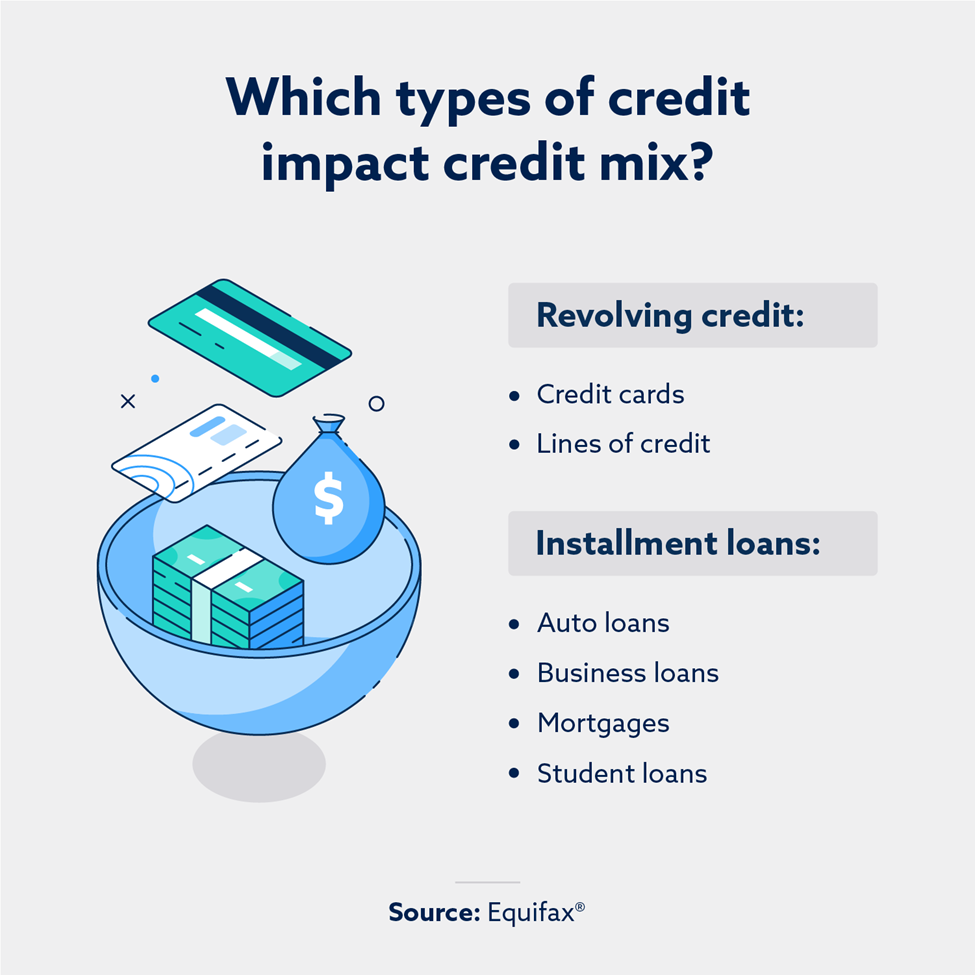
Your report is built from two main types of credit: revolving credit and installment credit. Revolving credit lets you borrow repeatedly up to a set limit, while installment credit involves a fixed loan amount repaid over a set schedule. Both are covered in more detail in the types of credit section below.
What Isn’t Part of Your Credit Mix
Debit cards, prepaid cards, utility bills and phone bills generally don’t count toward your credit mix, even though some services advertise that paying them on time can help your credit. These accounts can sometimes feed alternative credit-building tools, but they don’t change the core mix of revolving and installment accounts the way opening an actual credit account does.
Types of Credit That Make Up Your Mix
Every account on your credit report falls into one of two broad categories: installment credit or revolving credit. Some scoring discussions reference 3 types of credit by splitting revolving credit into cards and open lines of credit, but the practical distinction that matters for your mix is still installment versus revolving. Understanding the difference helps explain why a healthy credit mix means more than just having several credit cards.
Revolving Credit
Revolving credit is an account that lets you borrow repeatedly up to a preset limit, repay some or all of the balance and borrow again without reapplying. How much of that available limit you use, known as credit utilization, carries far more weight in your score than the mix itself, often accounting for around 30 percent of your FICO score on its own.
- Credit cards
- Home equity lines of credit (HELOCs)
- Personal credit lines
Installment credit works on a different repayment structure entirely, which is where the rest of your mix comes from.
Installment Credit
Installment credit is a loan for a fixed amount that you repay through scheduled payments over a set term, typically with the same payment amount each cycle. Because the loan amount and term are fixed up front, a single missed or late payment tends to carry a heavier, more immediate impact on this part of your mix than a single high-utilization month on a revolving account.
- Auto loans
- Home loans (mortgages)
- Student loans
- Personal loans
Both categories feed into how scoring models calculate your overall credit score, though not in equal measure.
How Credit Mix Affects Your Credit Score
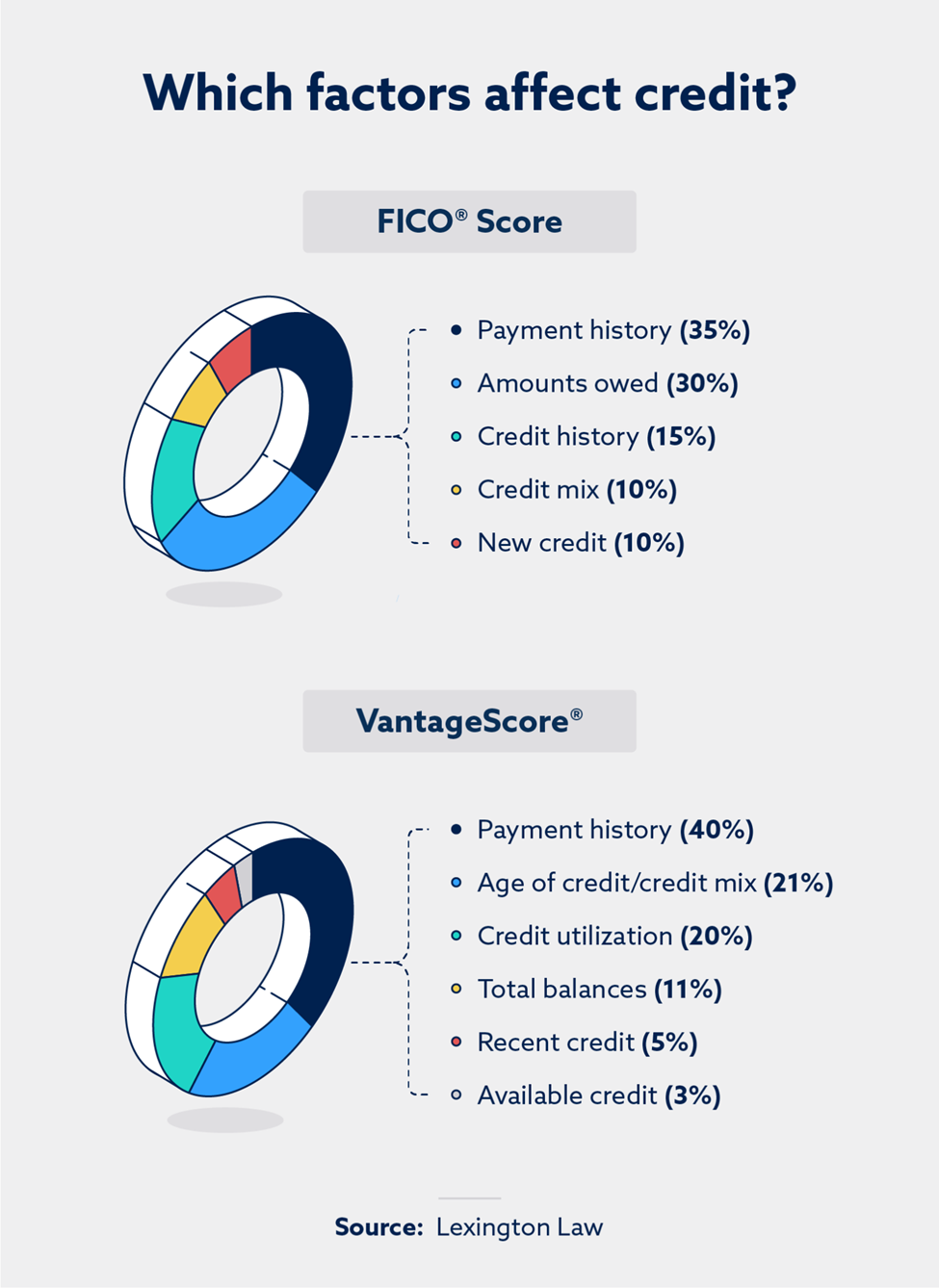
Credit mix affects your score modestly and somewhat differently depending on the scoring model a lender uses, since most rely on either FICO score or VantageScore, and each weighs credit mix on its own terms.
- FICO score: Credit mix makes up about 10 percent of the calculation, behind payment history (35 percent), amounts owed (30 percent), length of credit history (15 percent) and new credit (10 percent).
- VantageScore: Credit mix is grouped with credit age into a combined category worth about 21 percent, though payment history still carries the most weight at 40 percent.
In both models, a strong credit mix won’t outweigh a pattern of late payments or high balances. It’s worth optimizing once your payment history and utilization are already in good shape.
What Is a Good Credit Mix?
A good credit mix includes at least one revolving account and one installment account, managed responsibly over time. If you’re wondering how many lines of credit you should have, there’s no universal number, but a small handful of well-managed accounts across both categories typically serves the mix factor better than a large stack of similar accounts. For example, a single credit card paired with an auto loan and a mortgage is generally considered a healthier mix than six credit cards and nothing else, even though the six-card profile has more total accounts.
Different types of credit cards can also factor into a strong mix. Institutions like Equifax® note that holding two different types of revolving accounts, such as one card from a major bank and one retail store card, can support your credit profile, provided you manage both responsibly. The card type matters less than consistent on-time payments and low balances relative to each card’s limit.
Resist the urge to open new accounts solely to round out your mix. Each new application triggers a hard inquiry and lowers your average account age, both of which can dent your score in the short term, often outweighing whatever small benefit the improved mix might add.
If you’re unsure where your mix stands today, a free credit assessment from Lexington Law can show you which accounts are reporting and can help you flag anything that looks inaccurate or out of place.
How to Improve Your Credit Mix
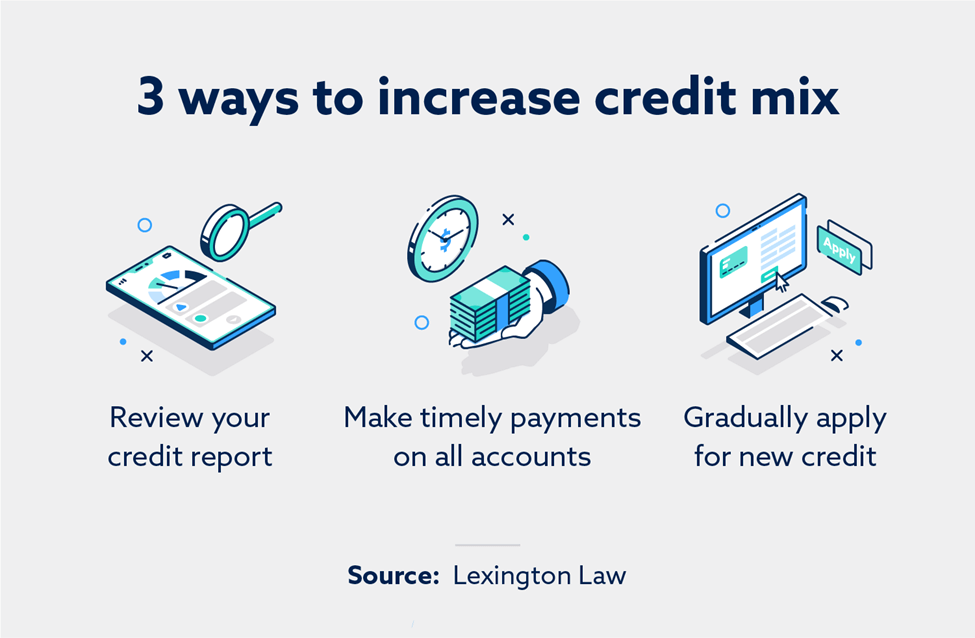
The most reliable way toimprove credit mix is to let it develop naturally as your financial needs call for new accounts, such as an auto loan when you buy a car or a mortgage when you buy a home, rather than opening accounts purely to diversify. The tips below can help you build credit with a healthier mix over time.
- Check your credit: Pull your report through annualcreditreport.com, a free resource that shows exactly which account types you already have and where your mix could use more balance.
- Consider a starter card: Secured cards and credit-builder cards are designed for applicants with limited credit history. They only help if you keep the account open and in good standing over time.
- Consider a credit-builder loan: If you don’t qualify for a conventional installment loan, a credit-builder loan offers a similar path to adding installment history to your file.
- Only open what you’ll use: An account you don’t plan to use regularly adds risk (forgotten payments, dormant balances) without adding meaningful benefit to your mix.
- Keep revolving balances low: Credit utilization has a much larger impact on your score than mix, so prioritize paying down revolving balances before chasing a more diverse mix.
- Be patient: New accounts take months to meaningfully influence your score, and the benefit compounds the longer you manage them well.
A better mix won’t move the needle much if inaccurate or outdated items elsewhere on your report are dragging your score down. That’s a separate problem with a separate fix.
Dispute Inaccurate Credit Mix Accounts with Lexington Law
Credit mix is a comparatively small piece of your overall score, but a single inaccurate or outdated entry, like a closed account misreported as open or a loan that doesn’t belong to you, can have an outsized impact on that piece. Reviewing your credit mix for errors is a reasonable next step once your payment history and utilization are already on track.
Lexington Law Firm’s advocates can help you identify and challenge inaccurate or unfair entries tied to your credit accounts, backed by decades of experience reviewing consumer credit reports. Start with a free credit assessment to see where your report stands today and which items might be worth disputing.
Credit Mix FAQs
Having many accounts doesn’t directly hurt your credit mix, since mix measures variety rather than volume. It can still hurt your broader score through lower average account age and a higher number of hard inquiries if those accounts were opened in a short window.
You don’t need every type of credit for a good credit mix. Having at least one revolving account and one installment account, both managed responsibly, is generally enough to satisfy this factor without taking on loans you don’t need.
Charge cards can count toward your credit mix as a form of revolving credit, though they typically require payment in full each month rather than carrying a balance. Holding one alongside a traditional credit card or installment loan can add variety to your profile.
Adding a second credit card when you already hold one provides little additional credit mix benefit, since both fall under the same revolving credit category. Your mix is more likely to improve by adding a different category, such as an installment loan, when your finances call for one.
Note: The information provided on this website does not, and is not intended to, act as legal, financial or credit advice. See Lexington Law’s editorial disclosure for more information.
Articles have only been reviewed by the indicated attorney, not written by them. The information provided on this website does not, and is not intended to, act as legal, financial or credit advice; instead, it is for general informational purposes only. Use of, and access to, this website or any of the links or resources contained within the site do not create an attorney-client or fiduciary relationship between the reader, user, or browser and website owner, authors, reviewers, contributors, contributing firms, or their respective agents or employers.